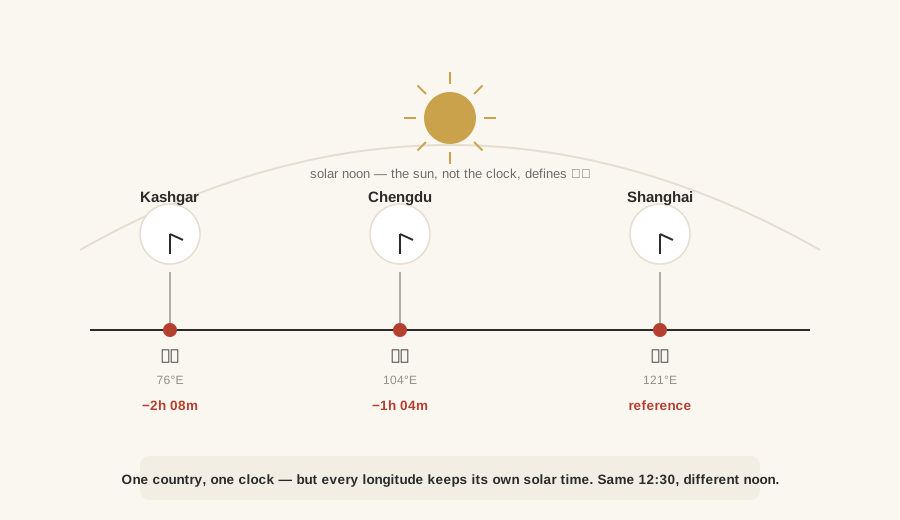
China runs on one clock: Beijing time, UTC+8, from Shanghai to the mountains of Xinjiang. That is convenient for trains and meetings. It is a problem for BaZi, because the hour pillar is not really about the clock — it is about where the sun was when you were born.
The two corrections
Longitude. The sun moves westward at roughly one degree every four minutes. Kashgar sits at 76°E, Shanghai at 121°E — about 45 degrees apart, which is about three hours of solar time. When an official clock in Kashgar reads 12:30, the sun there behaves as if it were closer to 10:20 in the morning. A birth "just after noon" in Shanghai and a birth "just after noon" in Kashgar are, solarly, different animals.
The equation of time. Even on the same meridian, the sun runs up to about 15 minutes ahead of or behind mean solar time across the year, because Earth's orbit is an ellipse and its axis is tilted. February and November are the extreme months.
Why a chart can flip
The traditional day divides into twelve two-hour branches, and the boundaries matter: 11:00–13:00 is noon (午, wu). Now take someone born 11:20 in Urumqi. By the clock, that is the noon branch. By the sun, it is mid-morning — the snake branch (巳, si). Different branch, different element, different hour pillar. When the hour pillar moves, the chart's "inner life" section moves with it, and the favourable element can change with it.
What we do
Our quiz asks for your birthplace because we compute longitude correction (and the seasonal equation of time) before fixing the hour pillar. It is one more field to fill in; it is also the difference between reading your chart and reading a chart that merely looks like yours. The full pipeline is described on our method page.
If you do not know your birth time at all: say so. The tradition has conventions for "hour unknown" charts — they lean on the day pillar alone, which is less precise but entirely workable.
Want this read on your own chart?
Two minutes, full birth data, no email needed — see which element your chart can actually use.
Keep reading
The twelve zodiac animals
Beyond the stereotypes: what your birth-year animal traditionally stands for.
Read the article → CultureWhich wrist to wear it on
Left or right? What tradition says — and why it matters less than sellers claim.
Read the article → CultureRed cords & your zodiac year
Why red is the colour of one's own year, and who traditionally wears it.
Read the article →