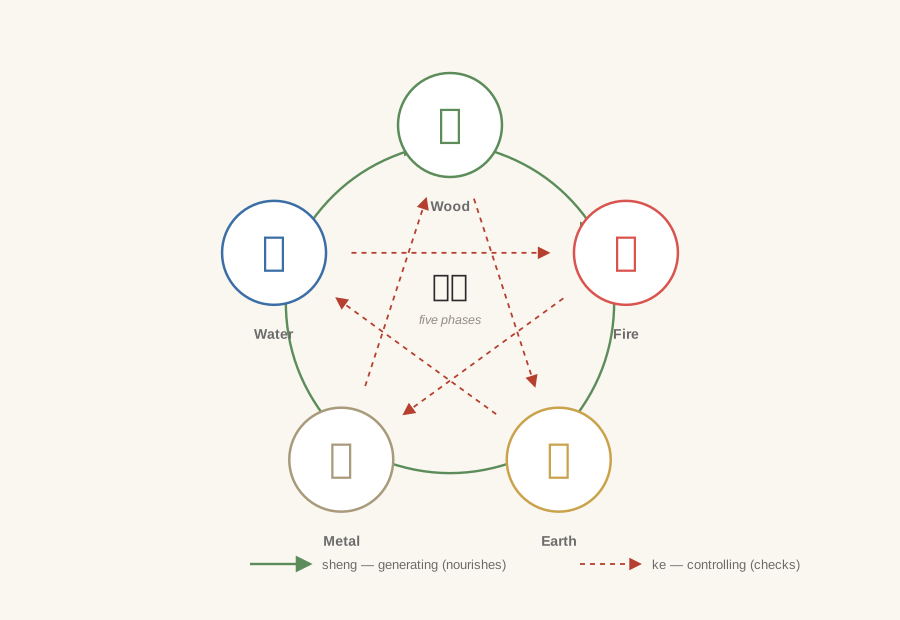
The first thing to unlearn: the five elements are not five substances. The Chinese word xing (行) means "to move, to act" — the elements are five kinds of process. The classical texts define them almost entirely by verbs:
- Wood 木 — "bending and straightening" (曲直): the force of growth, expansion, plans pushing upward.
- Fire 火 — "flaring upward" (炎上): heat, visibility, expression, the peak of something.
- Earth 土 — "sowing and reaping" (稼穑): stability, transition, the holding medium everything grows through.
- Metal 金 — "working and changing" (从革): structure, edges, refinement, the ability to cut and conclude.
- Water 水 — "moistening and descending" (润下): depth, adaptability, storage, things flowing to their level.
Two cycles, not one
Western pop-feng-shui usually stops at the "support cycle": wood feeds fire, fire makes earth (ash), earth bears metal, metal collects water (condensation), water nourishes wood. That ring is called sheng (生), generating. The classical system is just as interested in the second geometry — the ke (克) star: wood breaks earth, earth dams water, water quenches fire, fire melts metal, metal chops wood. Control is not hostility; it is what keeps any one element from running away with the whole chart.
A chart, a room, a team, a bracelet — the tradition reads all of them with the same question: which process here is overheated, and which one is starving?
The standard correspondences
| Element | Season | Direction | Colour | Classic feel |
|---|---|---|---|---|
| Wood | Spring | East | Green | starting, planning, growing |
| Fire | Summer | South | Red | visible, expressive, warm |
| Earth | Transitions | Centre | Yellow | steady, nourishing, grounding |
| Metal | Autumn | West | White | precise, structured, conclusive |
| Water | Winter | North | Black | deep, adaptable, stored |
These correspondences are why our five-element beads use their traditional colours — cinnabar red for fire, pale gold for earth, black obsidian for water — rather than arbitrary branding choices.
Where the elements show up in people
In BaZi the elements describe temperaments in the same seasonal language: a "wood person" plans and pushes, a "fire person" radiates, an "earth person" holds the middle, a "metal person" edits and refines, a "water person" adapts and reserves. Nobody is one element — everyone carries all five in different strengths, which is exactly what the eight characters tally.
Curious which way your own balance tips? The element quiz computes it from your full birth data in about two minutes.
Want this read on your own chart?
Two minutes, full birth data, no email needed — see which element your chart can actually use.
Keep reading
Favourable ≠ missing
The single most misunderstood rule in five-element advice, explained with a real chart.
Read the article → FoundationsTrue solar time
Why 12:30 in Kashgar is not 12:30 in Shanghai — and how it can change your chart.
Read the article → CultureThe twelve zodiac animals
Beyond the stereotypes: what your birth-year animal traditionally stands for.
Read the article →